
Published on November 16, 2026
Reading time: 10min
By Lucas Medus - Studio & Acoustics Expert at Red House
Sommaire
A small room can make an excellent home theater: it is easier to darken, to fill with sound and to treat acoustically. The key is to plan seating, screen size and speaker placement together, and to choose furniture and decor that save space.
A spare bedroom, a home office or a corner of the basement is often all you need for a private cinema. Below, you will find how to plan the layout, more than ten small home theater ideas that work in real rooms, and the sound and Dolby Atmos choices that make the biggest difference when every square foot counts.
- Small rooms: Small rooms are easier to darken, fill with sound and treat.
- Screen size: Choose screen size according to viewing distance, not wall size.
- Speakers: In-wall or in-ceiling speakers save space without sacrificing immersion.
- Seating: Compact recliners, loveseats or a single row keep the room comfortable.
- Acoustics: Acoustic treatment matters even more in a small room.
Can a small room make a great home theater?
Yes, and in some ways a small theater room is easier to get right than a large one. Fewer windows and less wall area mean it is quicker to block light completely, which is what makes a projector image look deep and contrasty. A smaller volume of air also needs less amplifier power and fewer speakers to reach cinema levels, so more of the budget can go to quality rather than quantity. And because every surface is close, a few well-placed acoustic panels change the sound far more than they would in a big family room.
A small space does come with limits you should plan for from the start:
Bass: in a compact room, low frequencies build up unevenly. Some seats get booming bass, others almost none.
Distance: you have less room to step back from the screen, and the back row often ends up against the rear wall.
Seating: one row of two to four seats is usually the realistic maximum.
Equipment: a projector, a subwoofer and an equipment rack all compete for the same few square feet.
None of these is a deal-breaker. They simply mean that layout, sound and design decisions need to be made together, before you buy furniture or cut holes in the ceiling.
Plan the layout first
In a small room, the order of decisions matters. Start with where you will sit, then size the screen to that distance, then place the speakers around the seats. Decor comes last, and it should work with that plan rather than against it.
Screen size and viewing distance
The right screen size depends on how far you sit from it, not on how wide the wall is. Industry guidelines are expressed as a viewing angle: SMPTE recommends that the screen fills at least 30° of your field of view, while THX recommends around 40° for a truly cinematic experience. In practice, multiply your viewing distance in inches by 0.65 for a comfortable "mixed use" screen and by 0.835 for an immersive one (Kaleidescape).
One row or two? Seating options for small rooms
In most small rooms, one row is the better choice. A second row needs a riser so that rear viewers can see over the heads in front, and it pushes the back seats against the rear wall, where bass is exaggerated and sound arrives muddled. A single row of two to four seats, set back from the rear wall, gives everyone a good seat.
If you need more places for movie night, add a few occasional seats rather than a full second row: a bench or a couple of ottomans behind the main seats, or a bar-height counter along the back wall. Our guide to home theater seating compares recliners, sofas and modular options in more detail.
Where to place the screen and the seats
A few rules make the biggest difference in a compact home cinema room:
Use the short wall for the screen when the room is rectangular, so you gain viewing distance and keep the side walls at equal distance from the seats.
Center the seats left to right. Sitting off-center shifts the sound image toward one side.
Keep the main seats away from the rear wall whenever possible; even 2 to 3 feet helps the bass and the surround effect.
Put the front speakers at seated ear level, about 3.9 feet from the floor according to Dolby, with the center channel just above or below the screen.
Leave a clear path to the seats and to the door, especially if the room has a dual use.
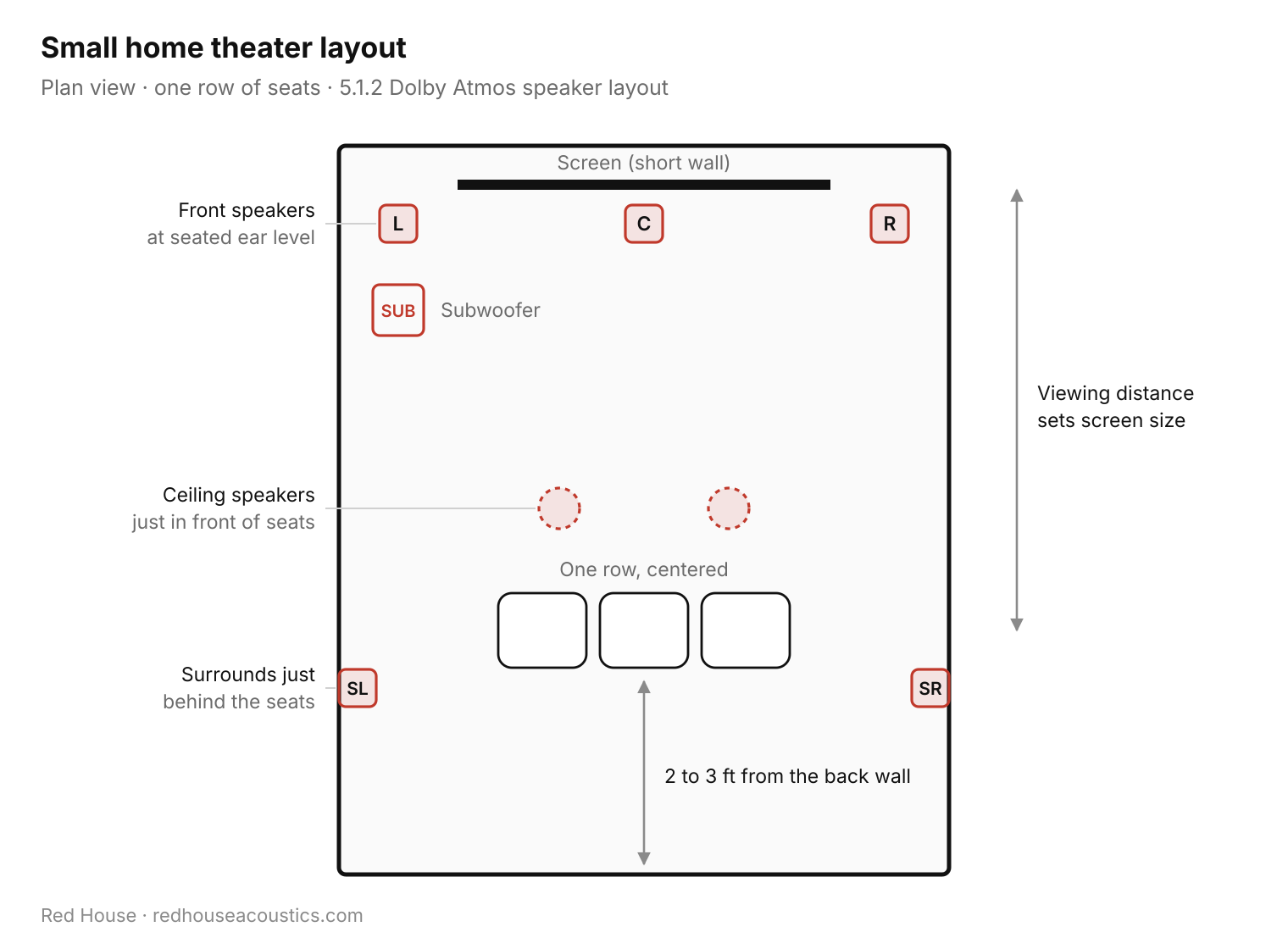
The screen sits on the short wall, the single row is centered and kept off the back wall, and the two ceiling speakers sit just in front of the seats.
Small home theater room design ideas
The best small home theater ideas do two jobs at once: they make the room look good and they improve the picture or the sound. Each idea below explains why it works in a small space.
Looking for inspiration for a larger room? Browse more home theater ideas or explore our custom home theater design ideas from real Red House projects.
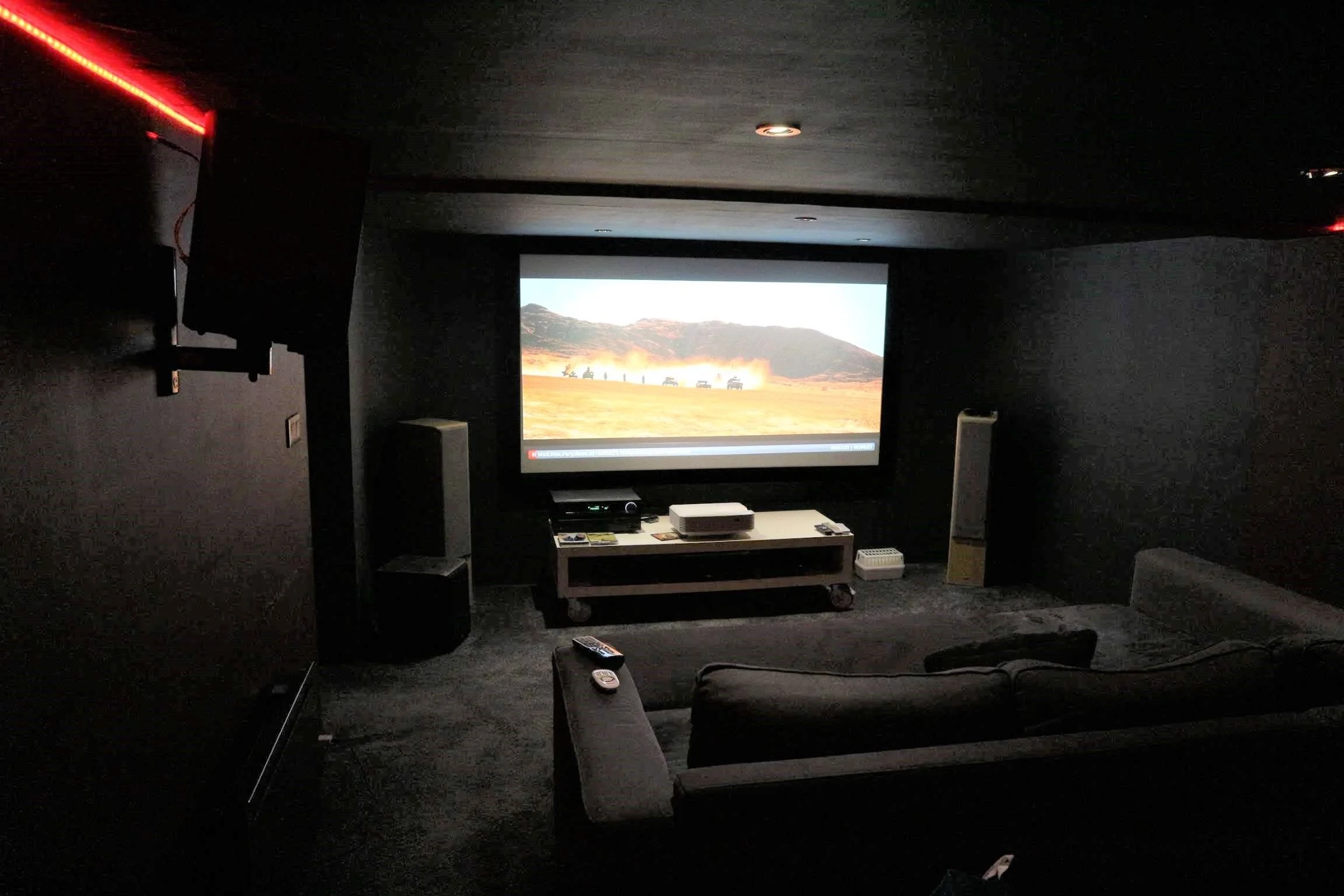
Dark walls and ceiling to "disappear" the room
Light from the screen bounces off pale walls and ceilings and washes out blacks. A dark, matte color scheme absorbs that stray light, so the image keeps its contrast. In a small room it has a second benefit: when the lights go down, the walls visually recede and the screen seems to float. Keep the darkest tones around the screen and on the ceiling, and use warmer, slightly lighter shades further back if you want the room to feel less enclosed by day.
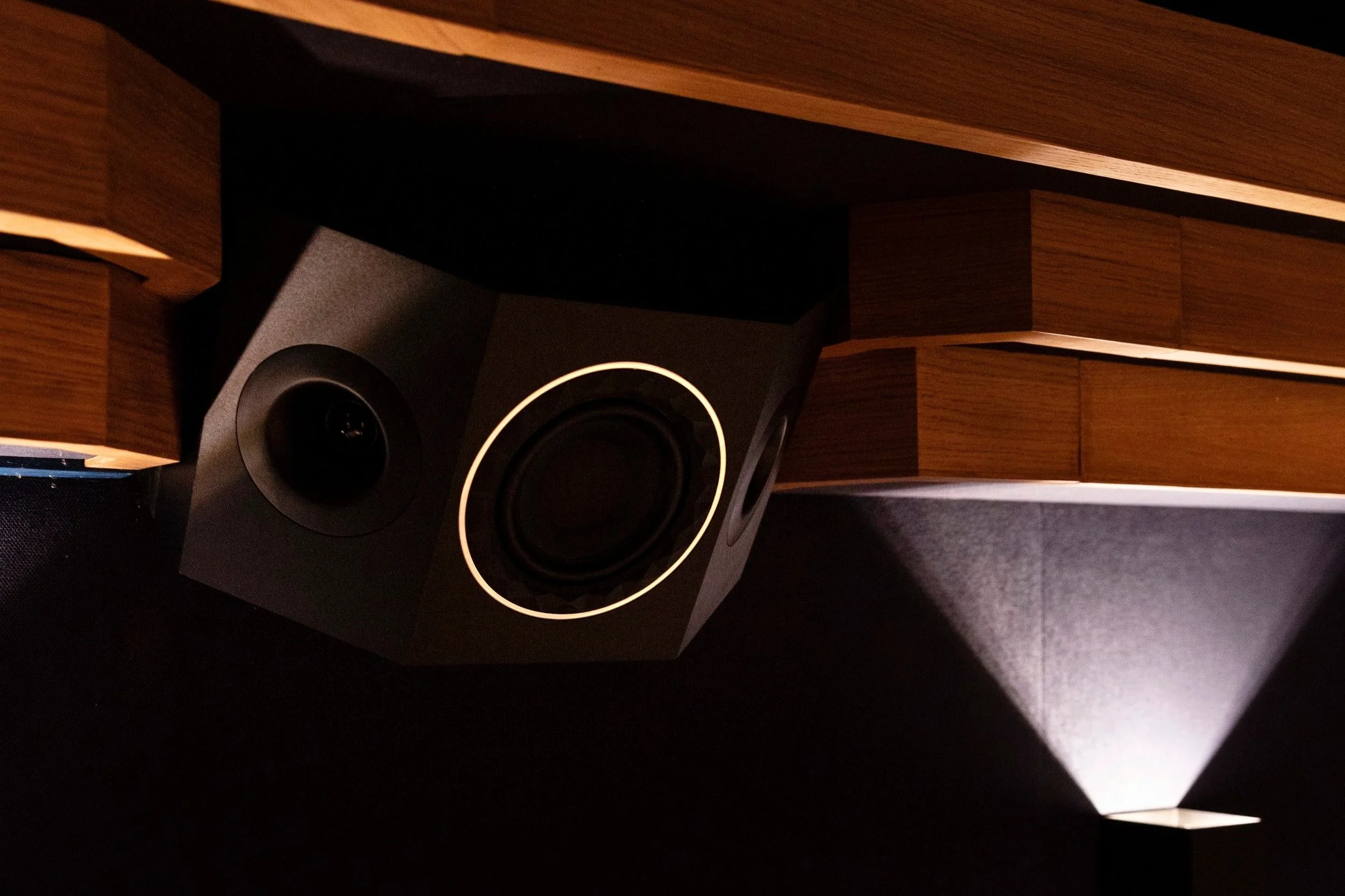
In-wall and in-ceiling speakers
Floor-standing speakers and stands eat into a small floor plan. In-wall and in-ceiling speakers give you a full surround sound system with nothing on the floor. Good architectural speakers, placed at the right height and angle, deliver the same immersion as boxes on stands. The key is to plan their positions from the seating layout, not from where the studs happen to be.
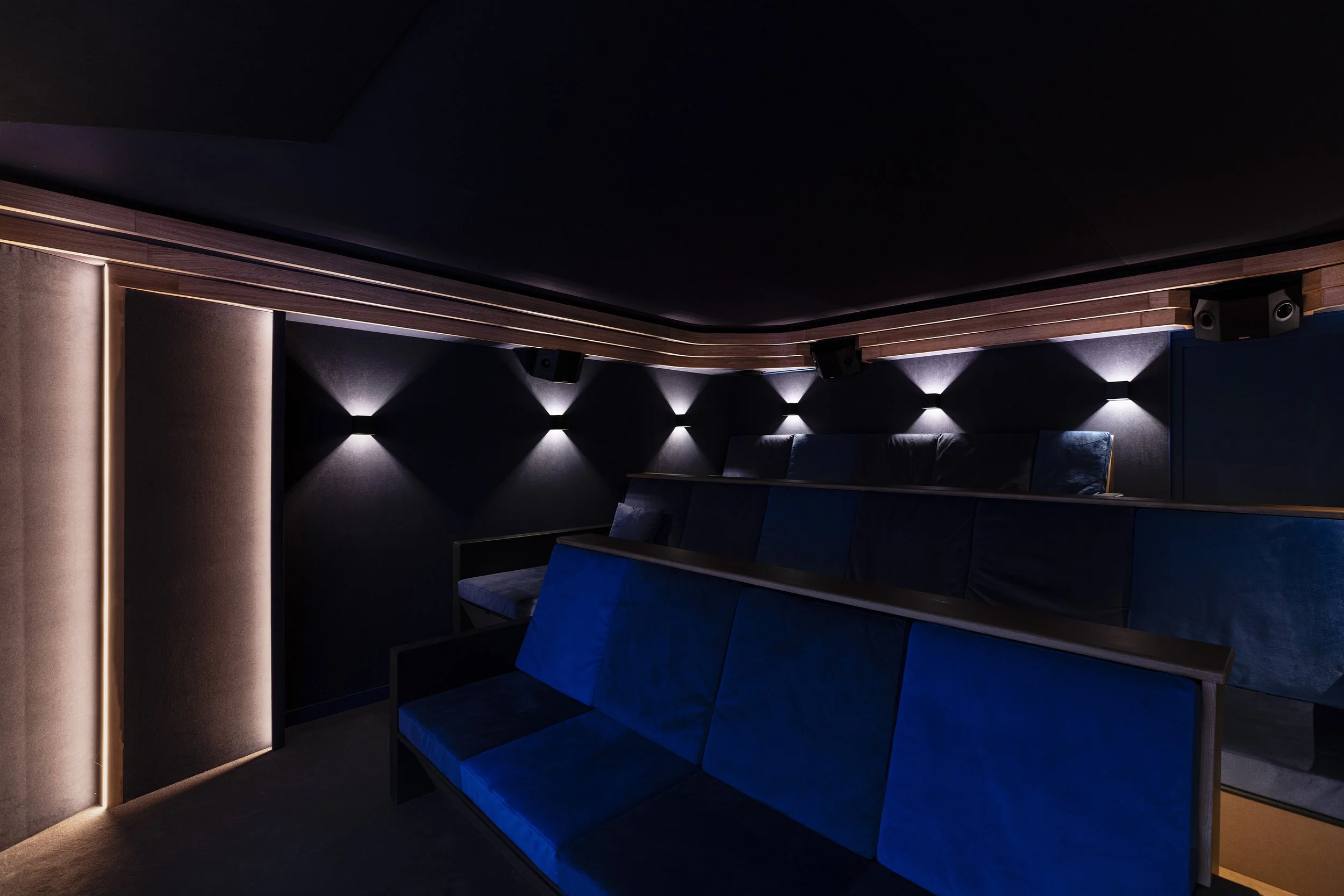
Acoustic fabric walls that hide treatment
A small room needs acoustic treatment, but a wall of visible foam panels rarely fits an interior design project. Stretched acoustic fabric solves both problems: absorbers, diffusers and even speakers sit behind a seamless, colored surface. You choose the color and texture, and the acoustical work stays invisible.
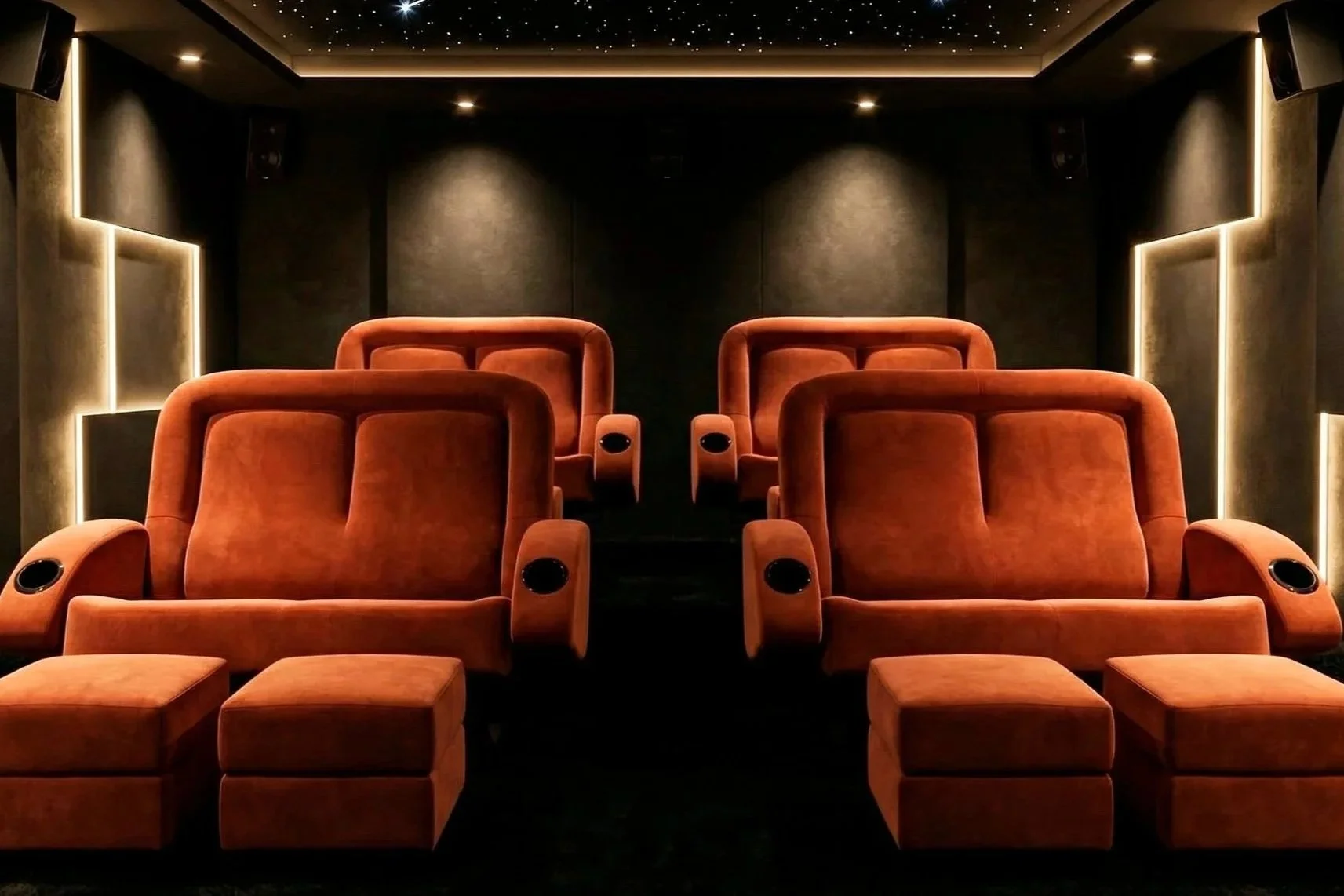
A loveseat or sectional instead of recliners
Full theater recliners need space behind them to recline and in front of them for the footrest. In a small media room, a deep loveseat or a compact sectional often seats the same number of people in less depth. Choose fabric over leather to soften reflections, add cushions for comfort, and look for wall-hugger recliners if you still want a reclining seat close to the rear wall.
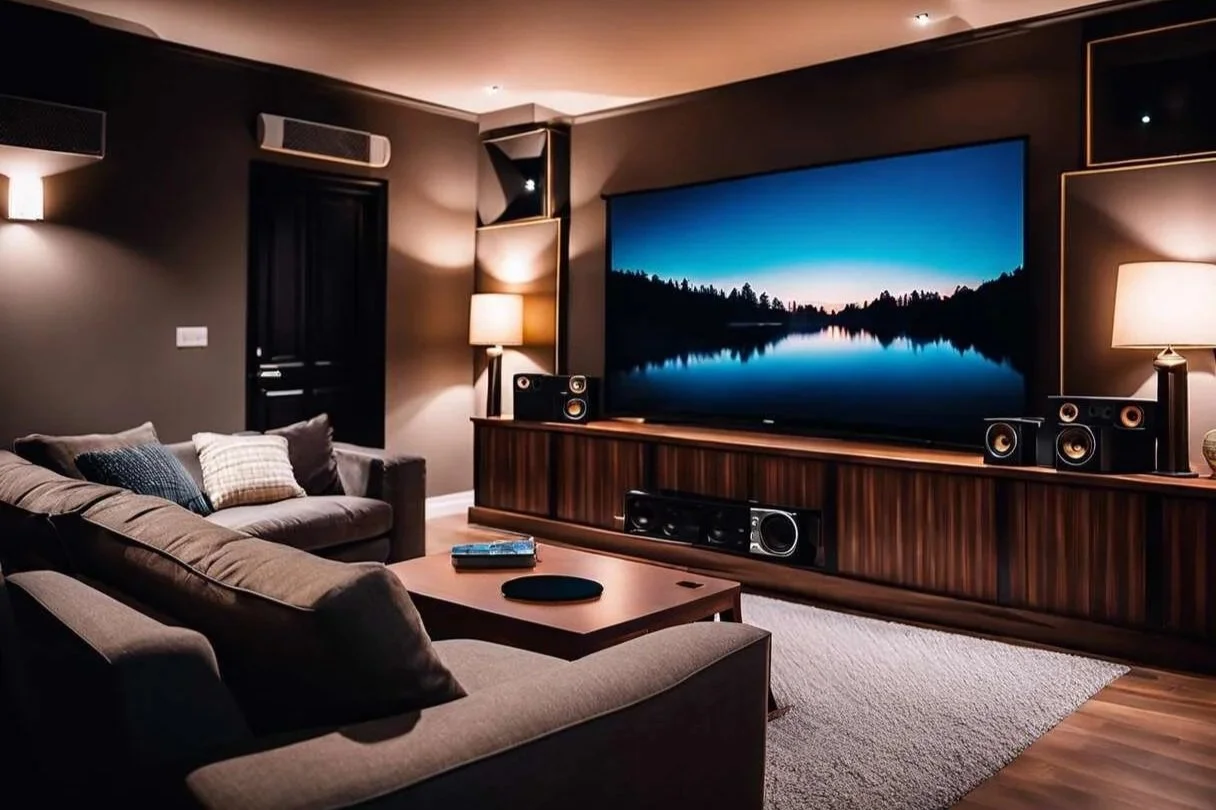
Short-throw projector or large TV
A standard projector needs a long throw distance, which is often more than a small room can give. Short-throw and ultra-short-throw projectors sit a few inches to a few feet from the screen, so there is nothing hanging over the seats. In a room that cannot be fully darkened, a large TV may be the better choice: today's 85- to 100-inch TVs cover most small-room viewing distances in the table above.
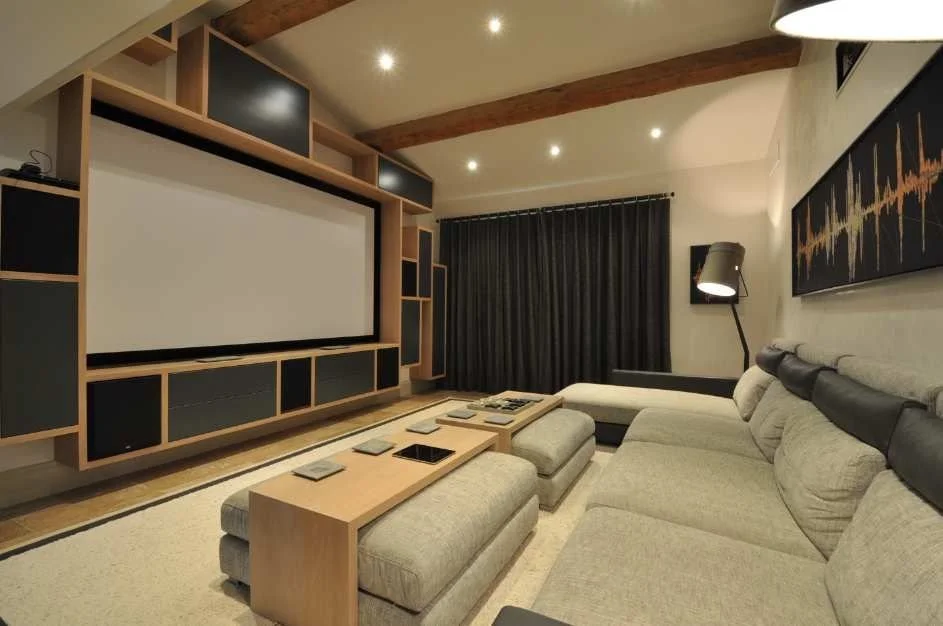
Built-in storage and hidden equipment rack
Custom cabinetry around the screen keeps the amplifier, streamer and subwoofer out of sight and gives you storage for remotes, blankets and games. Plan ventilation for the equipment, and keep the cabinet doors acoustically transparent where speakers sit behind them.
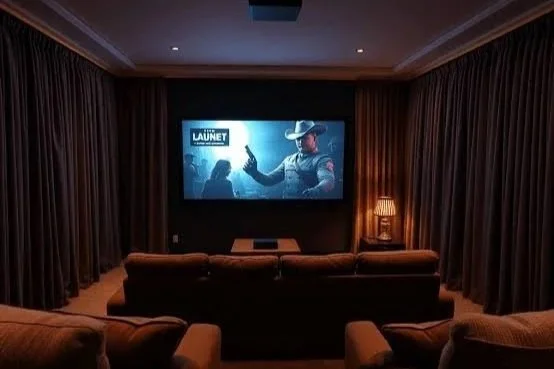
Blackout curtains and layered lighting
If the room has a window, heavy blackout curtains or drapes are essential, and their fabric also softens reflections. Then build lighting in layers: dimmable ceiling lights for cleaning and moving around, wall sconces or lamps for a soft glow, and low step lights for safety during the film. Put everything on a dimmer so that no light ever hits the screen. Our home theater lighting guide goes into fixtures and scenes.
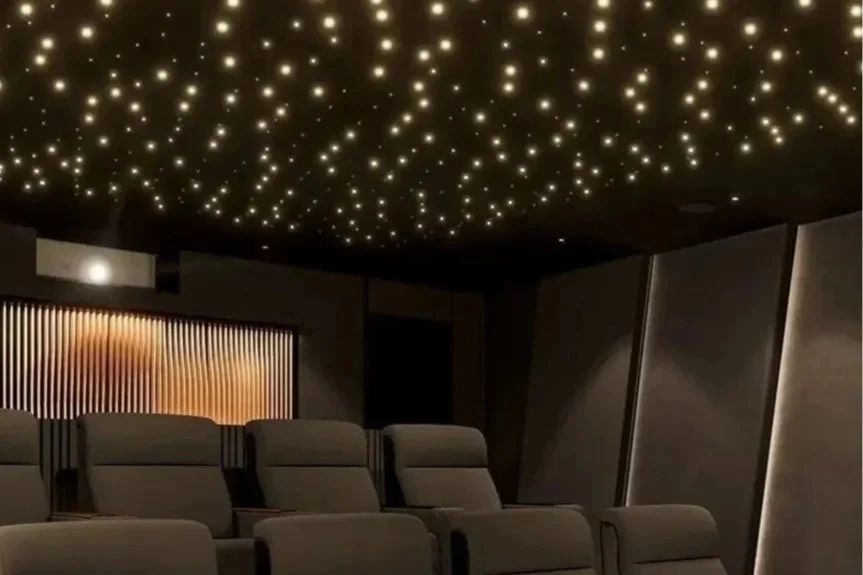
A starry ceiling or accent lighting
A fiber-optic starry ceiling or discreet LED strips behind a soffit add a sense of height and occasion without taking up any floor space. Keep them very dim during the movie and pick a warm color so they do not compete with the image.
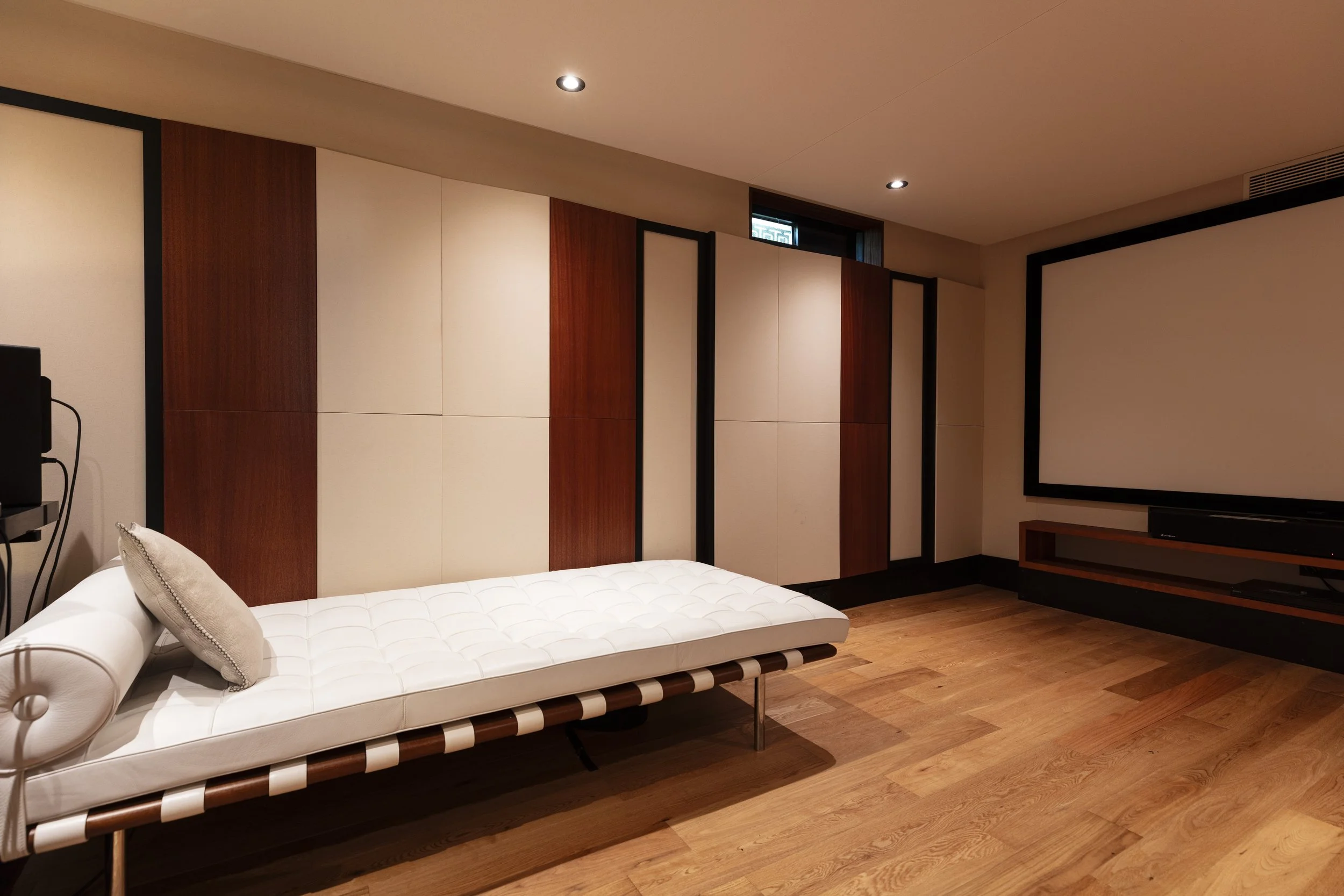
A dual-use room (office or guest room by day)
Many small home theaters are also an office, a guest room or a family room. Design for both uses: a sofa bed in front of the screen, a desk that folds into a wall unit, a motorized screen that drops in front of shelving. Speakers in walls and ceiling keep the room tidy by day. If the room is underground, our basement home theater guide covers humidity, ceiling height and sound isolation.
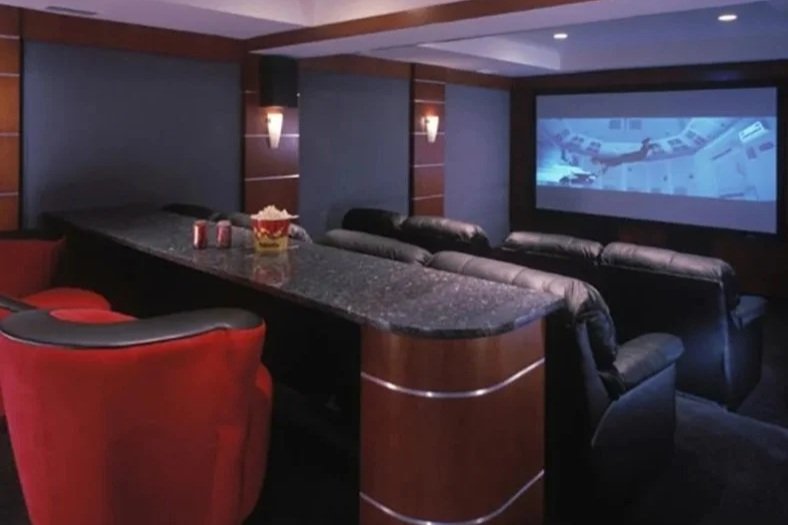
A snack corner in a nook
A shallow nook, an alcove or the space under a window can become a snack corner with a mini fridge, a counter and a popcorn machine. Keep it behind the seats and away from the screen wall, and use a dimmable under-counter light so it does not glow during the film.
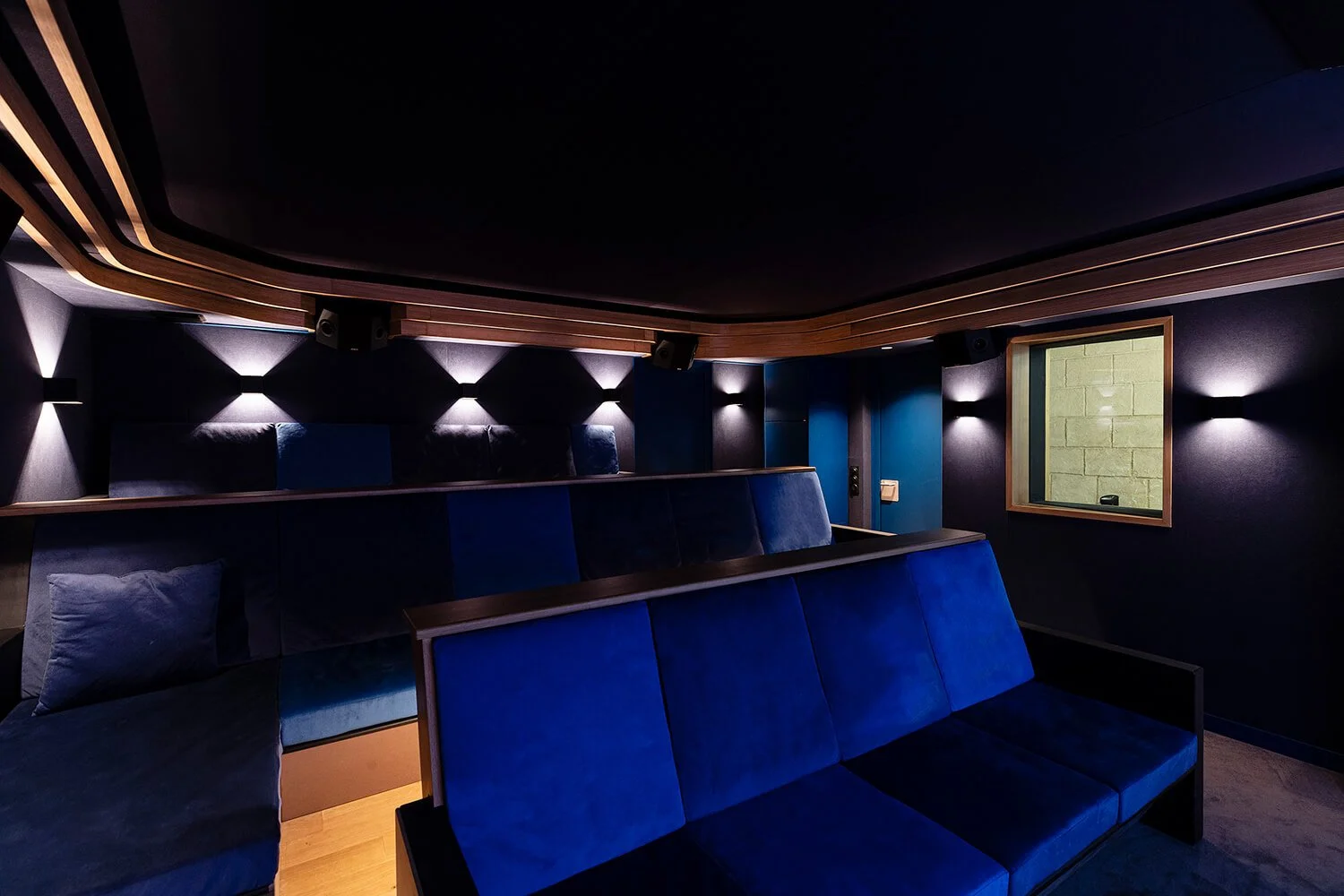
Bonus idea: a compact riser for a second row
If you really need two rows, a low riser of about 8 to 12 inches lets rear viewers see over the front seats, and it can double as storage. Check the ceiling height first, especially if you plan in-ceiling speakers above the back row.
Want a small home theater that feels like a private cinema?
Red House designs custom home theaters tailored to your room, from layout to acoustics and calibration.
Sound in a small room: what changes
In a small home theater, the room shapes the sound as much as the speakers do. Three things change compared with a large space.
Bass and room modes. Every room has resonant frequencies, called room modes, set by its length, width and height. In small rooms these problems reach higher up the frequency range and are very audible, as Harman's research points out. The result is uneven bass: a boom at one seat, a hole at the next.
First reflections. Side walls are close to the seats, so sound from the front speakers bounces off them and reaches your ears a split second after the direct sound. This blurs dialogue and the placement of effects. Absorbing panels at the reflection points on the side walls and ceiling clean up the image.
The right subwoofer. A bigger subwoofer is rarely the answer in a small room. Two smaller subwoofers, placed to complement each other, usually give more even bass across the seats. Research by Todd Welti at Harman showed that multiple subwoofers significantly reduce seat-to-seat variation (AES paper).
Acoustic treatment. Combine bass traps in the corners, absorption at the first reflection points and some diffusion at the back of the room. Red House designs these acoustic solutions to match the decor, often behind fabric.
In a small room, bass is often uneven: loud in some seats, weak in others. Subwoofer placement and bass traps usually help more than a bigger subwoofer.
Can you have Dolby Atmos in a small home theater?
Yes. Dolby itself notes that its placement guidance works in a small bedroom, a living room or a dedicated theater (Dolby). What changes is the configuration you choose.
5.1.2: five ear-level speakers, one subwoofer and two overhead speakers. It is the most common choice for a compact room, with the two overhead speakers in the ceiling, roughly above or just in front of the seats.
5.1.4: the same base with four overhead speakers, two in front of and two behind the seats. It gives a more precise "dome of sound" if the room is deep enough and the ceiling high enough to separate them.
In-ceiling vs. upward-firing: in-ceiling speakers fire straight down at the seats; upward-firing modules bounce sound off the ceiling. In-ceiling speakers are usually the more reliable choice when the ceiling is low, sloped or treated.
The main limits in a small room are a low ceiling, which puts overhead speakers too close to listeners' heads, and seats placed against the back wall, which leave no room for rear speakers. A well-designed Dolby Atmos home theater adapts the layout and speaker angles to the room so that the effect stays convincing at every seat.
Immersive sound, even in a small room.
Red House designs Dolby Atmos home theaters adapted to compact spaces.
How much does a small home theater cost?
There is no single price, because a small room can hold anything from a large TV with a compact surround system to a fully treated, calibrated private cinema. A smaller room does save money on some items (fewer speakers, less power, less fabric and treatment), but the quality of each element still sets the budget. The main cost items are:
Display: large TV, short-throw projector, or projector and projection screen.
Audio: speakers, subwoofer(s), AV receiver or processor and amplification.
Acoustic treatment: absorbers, bass traps, diffusers and fabric finishes.
Seating: recliners, loveseat or sectional, riser if needed.
Lighting and control: dimmers, sconces, accent lighting and a single remote or control system.
Construction and finishing: wiring, in-wall installation, cabinetry, sound isolation.
Design and calibration: layout plan, acoustic study and final tuning of picture and sound.
To set priorities and see where to save, read our guide to a budget home theater room.
Common mistakes in small home theaters
A screen that is too big for the distance. Bigger is not always better: past a 40° viewing angle, you start moving your head to follow the action. Use the table above, not the width of the wall.
Seats pushed against the back wall. It is tempting to gain distance this way, but bass becomes boomy and the surround speakers end up beside your ears instead of behind you.
Too many speakers. A 7.1.4 layout squeezed into a 10-by-12-foot room often sounds worse than a well-placed 5.1.2. Each speaker needs space to do its job.
Only hard surfaces. Bare walls, a wood or tile floor and a glass coffee table make the sound harsh and dialogue hard to follow. Add a rug, fabric seating, curtains and proper acoustic treatment.
No light control. A single ceiling light and an uncovered window ruin the picture. Plan blackout curtains and dimmable, layered lighting from the start.
Why choose Red House for your small home theater?
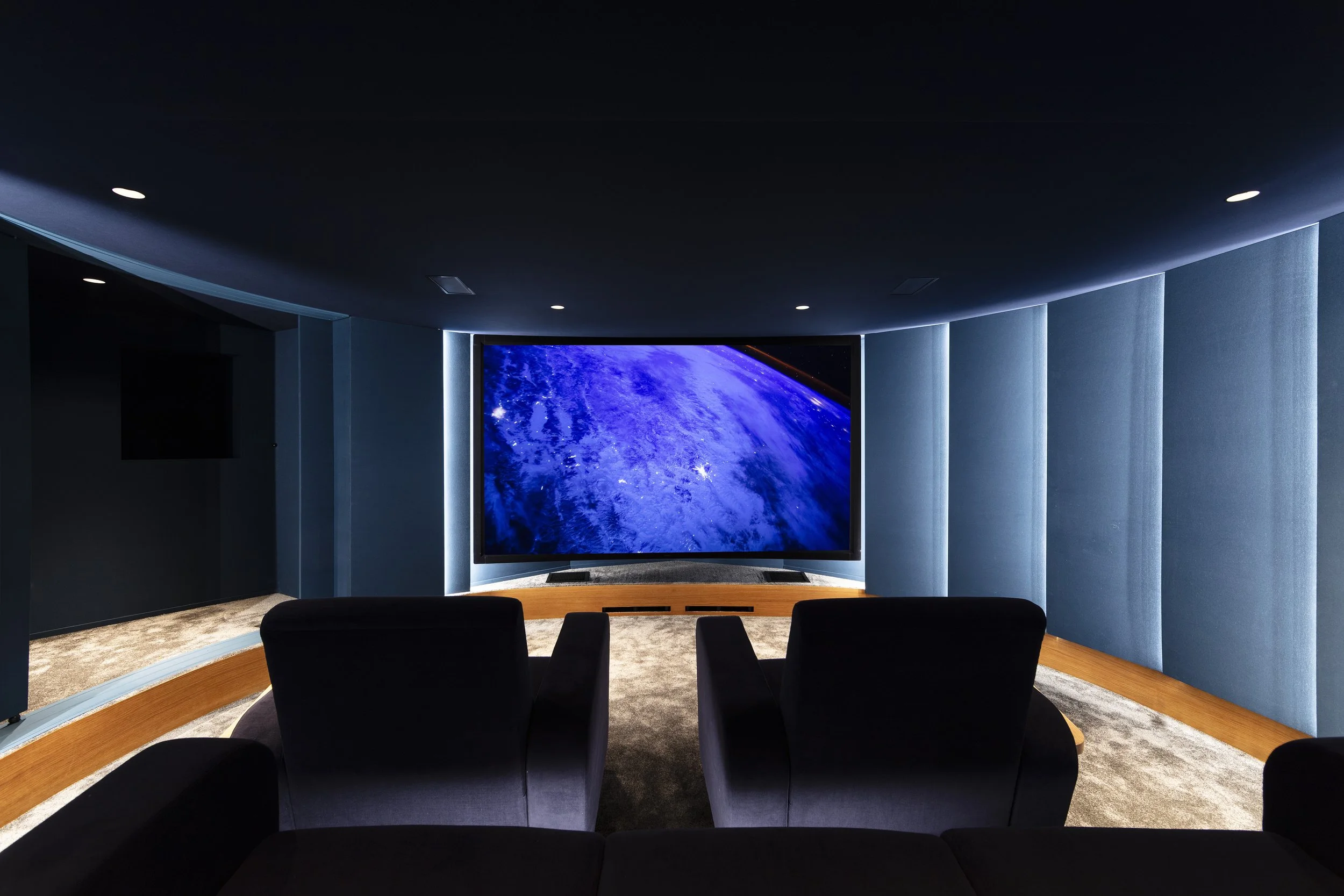
La Chaumière by Red House
In a small room, every inch and every decision counts. Red House designs each home theater around your space rather than around a standard package:
Custom design: seating, screen size and speaker positions planned together from your room's real dimensions.
Acoustics: treatment designed for the room, integrated into the decor so it looks like interior design, not a studio.
Integrated furniture: custom cabinetry, hidden equipment and storage that make the most of a small footprint.
Calibration: picture and sound tuned at the seats, so the room performs as designed on the first movie night.
Small home theater room design: frequently asked questions
-
The minimum room size for a home theater is not set by any official standard. In practice, a typical spare bedroom of around 10 by 12 feet can host a real home theater with one row of two to three seats, a large screen and a 5.1 or 5.1.2 system. What matters more than square footage is leaving some space between the seats and the back wall and having enough ceiling height for overhead speakers.
-
The right screen size for a small home theater depends on your viewing distance. Multiply that distance in inches by 0.65 for a comfortable screen and by 0.835 for an immersive one. At 8 feet, this means a screen of roughly 62 to 80 inches diagonal; at 10 feet, a screen of 78 to 100 inches.
-
A projector is a good idea in a small room, as long as you can darken the room. Small rooms are easy to black out, which suits projectors. If the room is too shallow for a standard throw distance, choose a short-throw or ultra-short-throw model. If the room keeps daylight, a large TV is often the safer choice.
-
In a small home theater, you need at least a 5.1 system, which means five speakers and one subwoofer. For Dolby Atmos, a 5.1.2 layout adds two in-ceiling speakers and suits most small rooms. Adding a second subwoofer often improves bass more than adding more surround speakers.
Ready to turn your basement into a private cinema?
Red House designs and builds custom home theaters tailored to your space.
Sources & References
- Dolby: Dolby Atmos speaker setup and 5.1.2 overhead speaker setup guide (PDF)
- Kaleidescape: Screen size, viewing distance & resolution
- Harman: Bass in small rooms and multiple subwoofers
- Audio Engineering Society (AES): Welti & Devantier, Low-Frequency Optimization Using Multiple Subwoofers (2006)