
Office Acoustic Solutions
Published on April 15, 2026
Reading time: 8 min
By Lucas Medus - Studio & Acoustics Expert at Red House
Sommaire
Silence is the new luxury in the modern workplace. Our comprehensive approach to office acoustics blends aesthetic excellence with scientific precision. Through expert acoustic consulting, we help you navigate the challenges of open-office noise, delivering bespoke solutions that sound as good as they look.
Why Office Acoustics Matter in Open-Plan Workspaces?
In the era of modern collaboration, the open-plan layout has become a standard. However, without proper acoustic management, these spaces often become hubs of distraction. Excessive noise levels lead to increased stress, mental fatigue, and a significant drop in productivity.
Effective office acoustics are not just about "silence"; they are about creating an environment where employees can focus on deep work while still being able to communicate effortlessly when needed. Investing in sound quality is investing in your team’s long-term well-being and operational efficiency.
What Are Office Acoustic Solutions?
Navigating the world of acoustics requires understanding a few key concepts. Here is a breakdown of the solutions we provide through our acoustic consulting services:
Acoustic Treatment: The general process of improving the sound quality within a room using specialized materials.
Sound Absorption vs. Soundproofing: > The Difference: Sound absorption uses soft materials (like panels) to stop sound from bouncing inside a room (eliminating echoes). Soundproofing involves blocking sound from traveling between rooms (isolation).
Reverberation Control: Managing the "echo" effect. By reducing the time sound lingers, we create a calmer, more controlled atmosphere.
Speech Clarity: Ensuring that voices are crisp and clear during meetings without having to raise one's voice, which is essential for conference rooms.
Noise Reduction vs. Isolation: While reduction lowers the overall ambient noise level, isolation creates a physical or acoustic barrier to protect sensitive areas from external sounds.
What Are the Main Sources of Noise in Modern Offices?
Identifying the culprits is the first step toward a solution. Common sources include:
Ambient Chatter: Spontaneous conversations and phone calls in open areas.
Mechanical Systems: HVAC units, printers, and server cooling fans.
Impact Noise: Footsteps on hard flooring or furniture being moved.
External Pollution: Traffic, construction, or sirens leaking through windows and walls.
How Is Office Acoustic Performance Measured?
To provide accurate results, we rely on scientific metrics to benchmark your workspace’s performance:
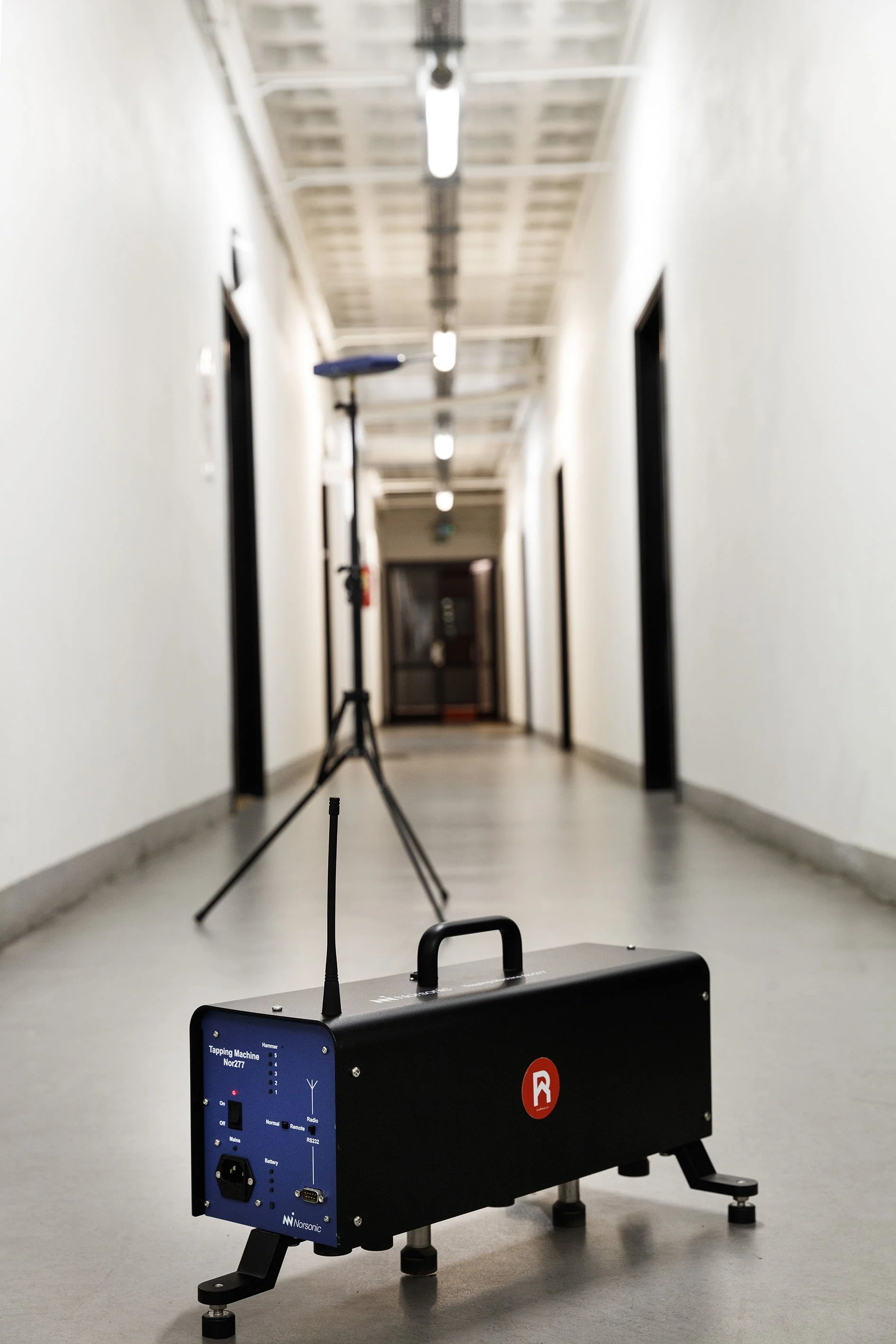
Decibel Levels (dB): We measure the intensity of sound to ensure it remains within healthy and productive ranges (typically between 45 dB and 55 dB for office work).
Reverberation Time (RT60): This measures how long it takes for a sound to decay by 60 decibels. A lower RT60 means less echo and better focus.
Speech Transmission Index (STI): A scale from 0 to 1 that determines how well speech is understood. In meeting rooms, we aim for a high STI; in open offices, a lower STI between workstations helps maintain privacy.
Acoustic Comfort Benchmarks: We compare your data against international standards (such as ISO 3382-3) to certify that your office meets global workplace comfort requirements.
Practical Office Acoustic Solutions
Installing the right equipment is essential to transforming your work environment.
Here are various acoustic solutions that we can categorize as follows:
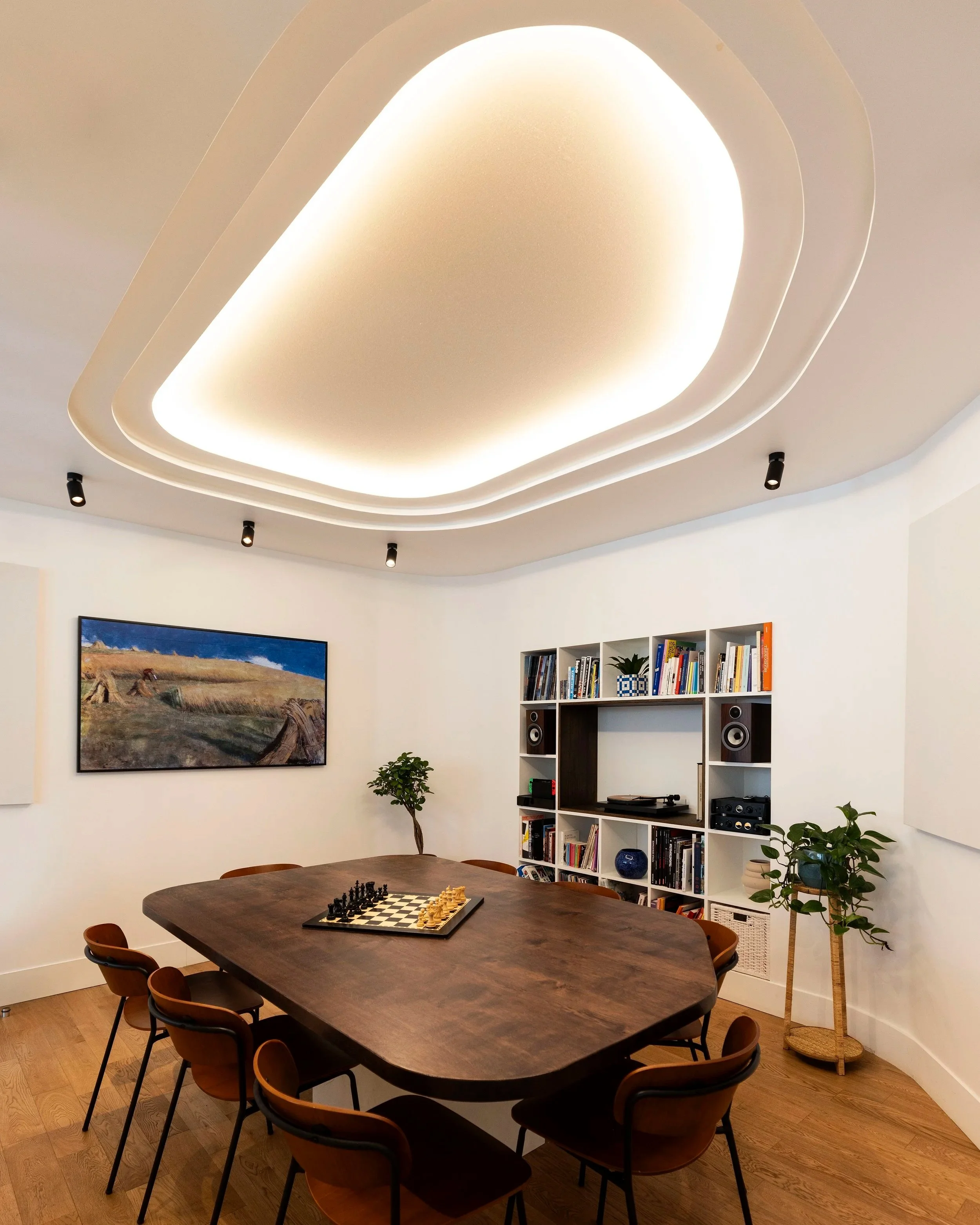
Acoustic panels and ceiling treatments
The ceiling and walls are the largest reflective surfaces in any office. By installing high-performance acoustic panels (wall-mounted) or baffles and clouds (suspended from the ceiling), we can capture sound waves before they bounce, drastically reducing ambient noise and echo.
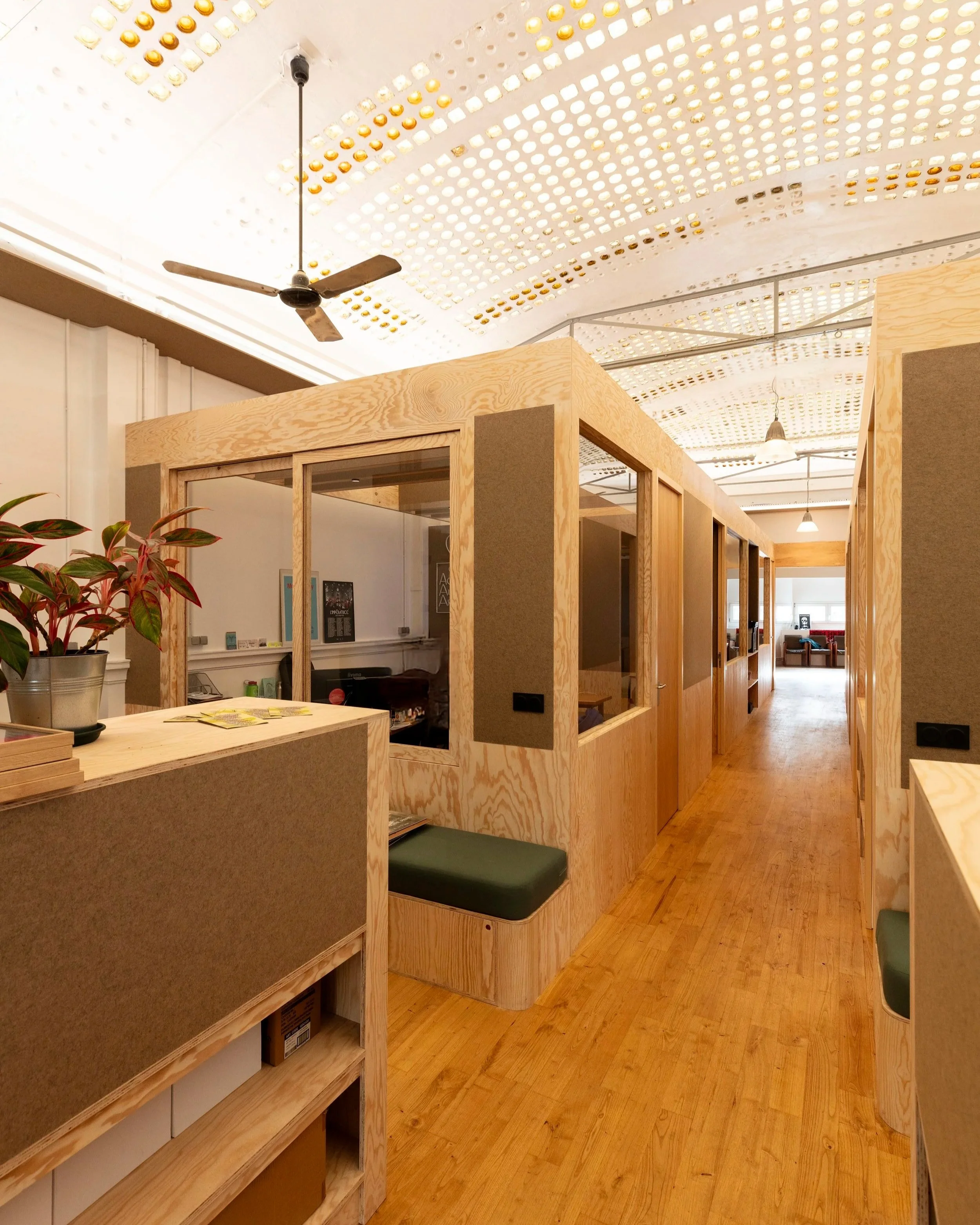
Acoustic partitions and zoning strategies
Open offices benefit from "acoustic zoning." Using freestanding partitions or desk screens, we create physical and auditory boundaries. These help delineate quiet focus areas from collaborative hubs without sacrificing the airy feel of an open plan.
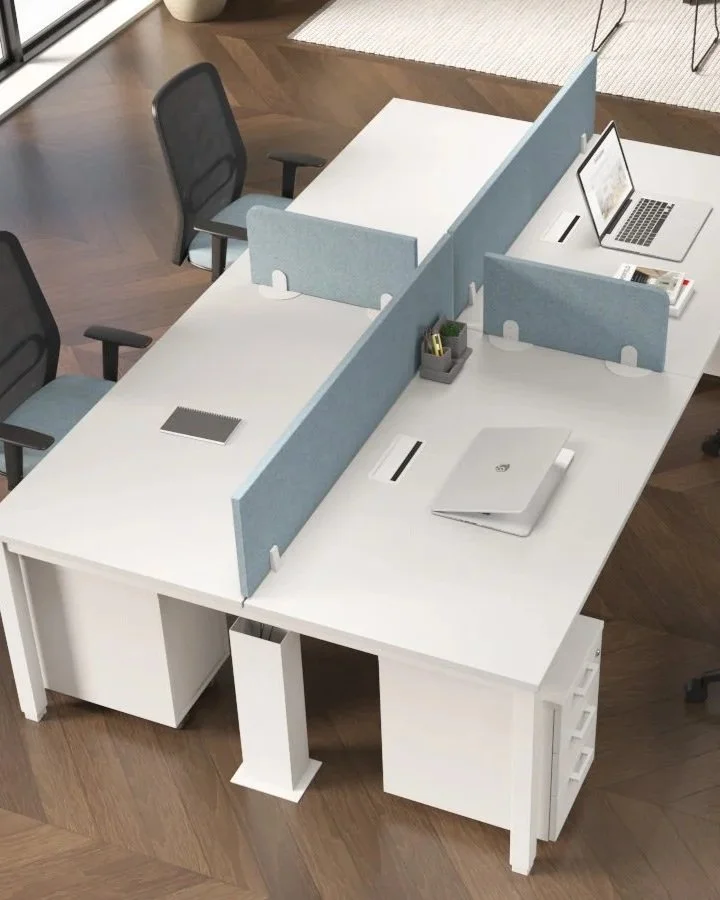
Acoustic furniture and integrated solutions
Modern office furniture can do double duty. From high-back sofas that act as natural sound barriers to storage units with perforated acoustic backing, these elements integrate sound management directly into your office layout.
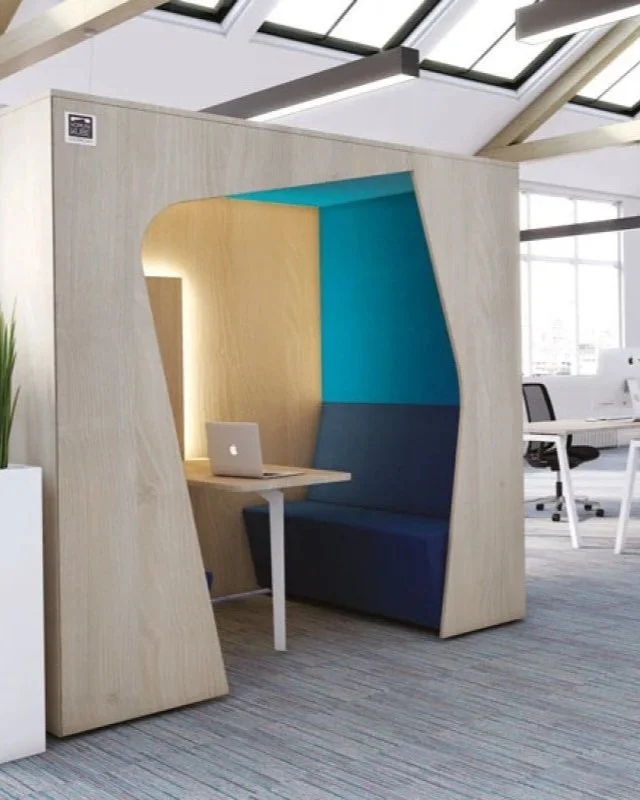
Acoustic booths and pods
For maximum privacy, acoustic pods offer a "room-within-a-room" solution. These are perfect for confidential calls, focused individual work, or small private meetings, ensuring that what is said inside stays inside—and outside noise stays out.
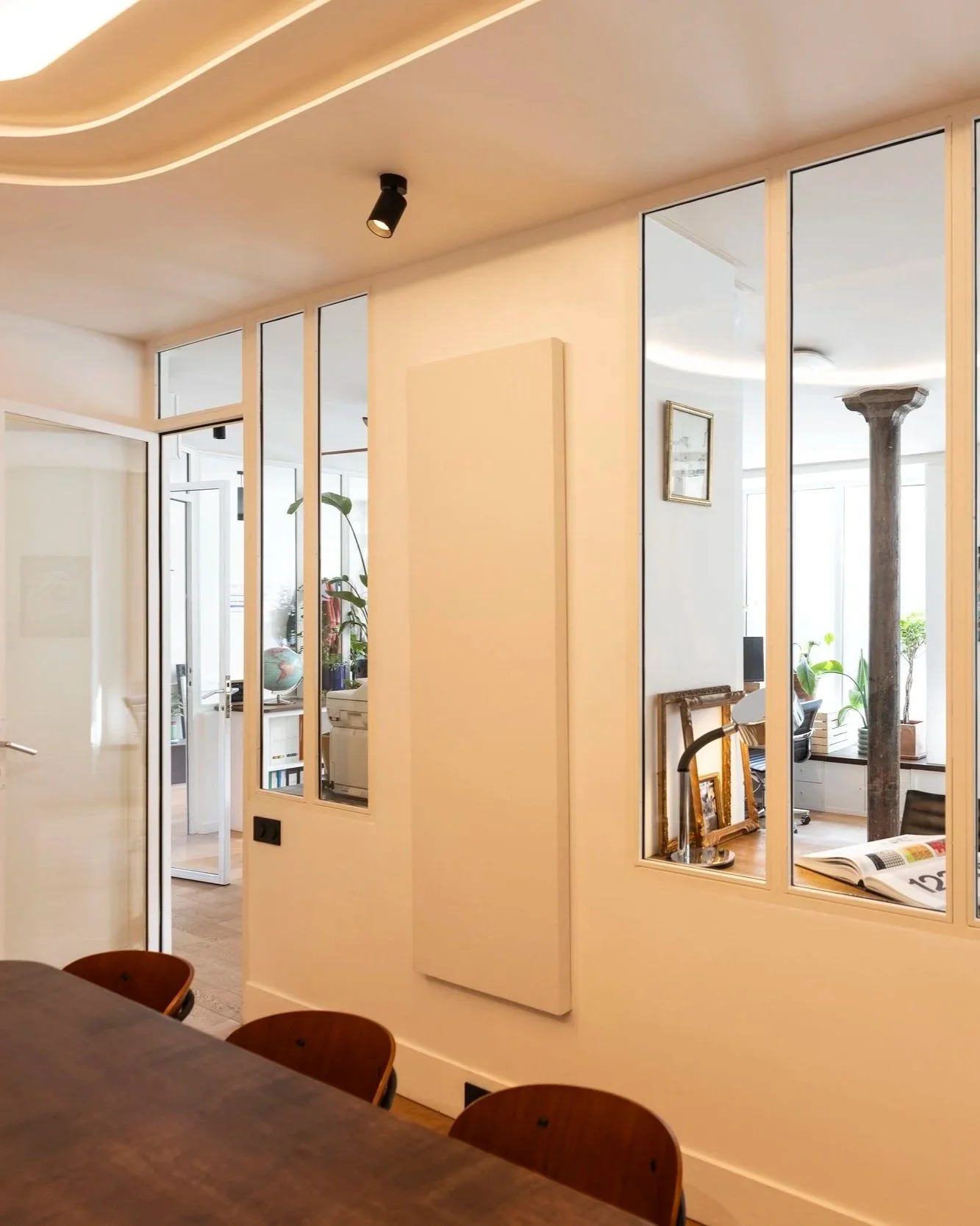
Soundproofing strategies when isolation is required
When simple absorption isn't enough—such as for boardroom privacy or sensitive HR offices—we implement structural soundproofing. This includes high-STC (Sound Transmission Class) glass partitions, acoustic door seals, and wall insulation to prevent sound leakage between sensitive zones.
Common Mistakes in Office Acoustic Design
Even with a budget, many companies fail to achieve acoustic comfort due to common pitfalls. Our acoustic consulting helps you avoid these:
Relying only on furniture: While soft seating helps, it rarely has the surface area or density required to solve major reverberation issues. A holistic approach (ceiling + walls + floor) is necessary.
Ignoring low frequencies: Many standard panels only absorb high-pitched sounds. Without addressing low-frequency "hum" (like HVAC or distant traffic), the office can still feel oppressive or "boomy."
Over-treating certain zones: More isn't always better. An "over-deadened" room can feel unnatural and claustrophobic. The goal is balance, not total silence.
Neglecting ceiling height: In offices with industrial exposed ceilings, sound travels further and faster. Ignoring the overhead space often renders wall treatments ineffective.
Poor placement of materials: Putting expensive acoustic panels in corners where no one speaks or works is a waste of resources. Effective placement follows the "source-path-receiver" logic.
How to Improve Acoustics in an Existing Office
Improving an active workspace doesn't always require a full renovation.
We follow a structured 4-step process to ensure a significant ROI on your acoustic comfort:
Step 1: Diagnose – We begin by identifying the specific noise issues. Is it an echo problem, or is sound leaking from the street? A professional audit pinpointing "hotspots" saves time and budget.
Step 2: Treat Reverberation – We tackle the "echo" by adding absorbent materials to the most reflective surfaces (usually the ceiling and upper walls) to bring the RT60 levels down to a comfortable range.
Step 3: Create Acoustic Zoning – We reorganize the layout using acoustic dividers and furniture to separate high-activity areas (like coffee corners) from quiet focus zones.
Step 4: Evaluate the Need for Soundproofing – Finally, we assess if certain areas require structural isolation, such as adding acoustic seals to doors or installing soundproof booths for confidential conversations.
When Is a Professional Acoustic Study Necessary?
While minor adjustments can help, a professional acoustic study is essential for complex environments or large-scale offices. Acoustics is a science of precision; even a small gap under a door or the wrong choice of material can render an entire installation ineffective. An expert study provides you with measurable data, 3D sound mapping, and guaranteed results. It ensures that your investment actually solves the problem rather than just masking it, providing a workspace that meets legal standards and truly supports your employees' cognitive health. Interestingly, this exact same need for expert calibration applies across all performance-critical spaces, whether performing a high-precision concert hall acoustic simulation, tuning a venue for effective restaurant acoustics, or designing tailored workplace environments.
Is Your Workspace Truly Optimized Acoustically?
Office Acoustics and Workplace Noise Regulations
Compliance is not just about comfort; it is a legal and ethical requirement. Excessive noise is recognized as a workplace hazard that can lead to long-term health issues.
OSHA and Workplace Standards: We ensure your office adheres to OSHA guidelines and international standards (such as ISO 22955) specifically designed for acoustic quality in open-plan offices.
Employer Responsibility: Employers have a "duty of care" to provide a safe working environment. Reducing noise pollution is a key factor in mitigating stress, preventing hearing fatigue, and supporting neurodiversity in the workplace.
Acoustic Compliance in Commercial Spaces: Whether you are pursuing WELL or LEED certification, our solutions help you earn vital points for indoor environmental quality, increasing the overall value and attractiveness of your real estate.
Designing Sustainable and Scalable Acoustic Workspaces
We believe that acoustic solutions should be a long-term investment rather than a temporary fix, which is why we prioritize long-term performance by selecting high-quality, durable materials that maintain their sound-absorbing properties over time without sagging or degrading.
To ensure that acoustics are never an afterthought, we work closely with architects to achieve a seamless integration with architecture, creating treatments that perfectly complement a building’s aesthetic—from industrial lofts to sleek glass-walled headquarters. Furthermore, because the modern office is constantly evolving, we focus on flexible and modular solutions, offering a range of partitions and movable pods that can be easily reconfigured as your team grows or your floor plan changes.
Why Choose Red House for Office Acoustic Projects?
Choosing Red House means choosing a partner that views acoustics through the lens of both science and design.
»Engineering-led approach
We don't just sell panels; we provide answers. Our process is rooted in data-driven acoustic consulting. We use precise measurements and simulation tools to predict results before a single panel is installed.
»Custom acoustic design
Every building has a unique "sonic signature." We offer bespoke solutions—from custom-printed acoustic art to specifically tuned baffles—ensuring that your acoustic treatment is as unique as your brand.
»Integration with architecture and workflow
We understand how offices breathe. Our designs prioritize unobtrusive integration, ensuring that sound management enhances your existing workflow and interior design rather than disrupting it.
»Proven experience in complex environments
From high-ceilinged industrial renovations to high-density call centers, Red House has a track record of solving the most challenging acoustic puzzles. We deliver quiet, productive environments where others only see noise.
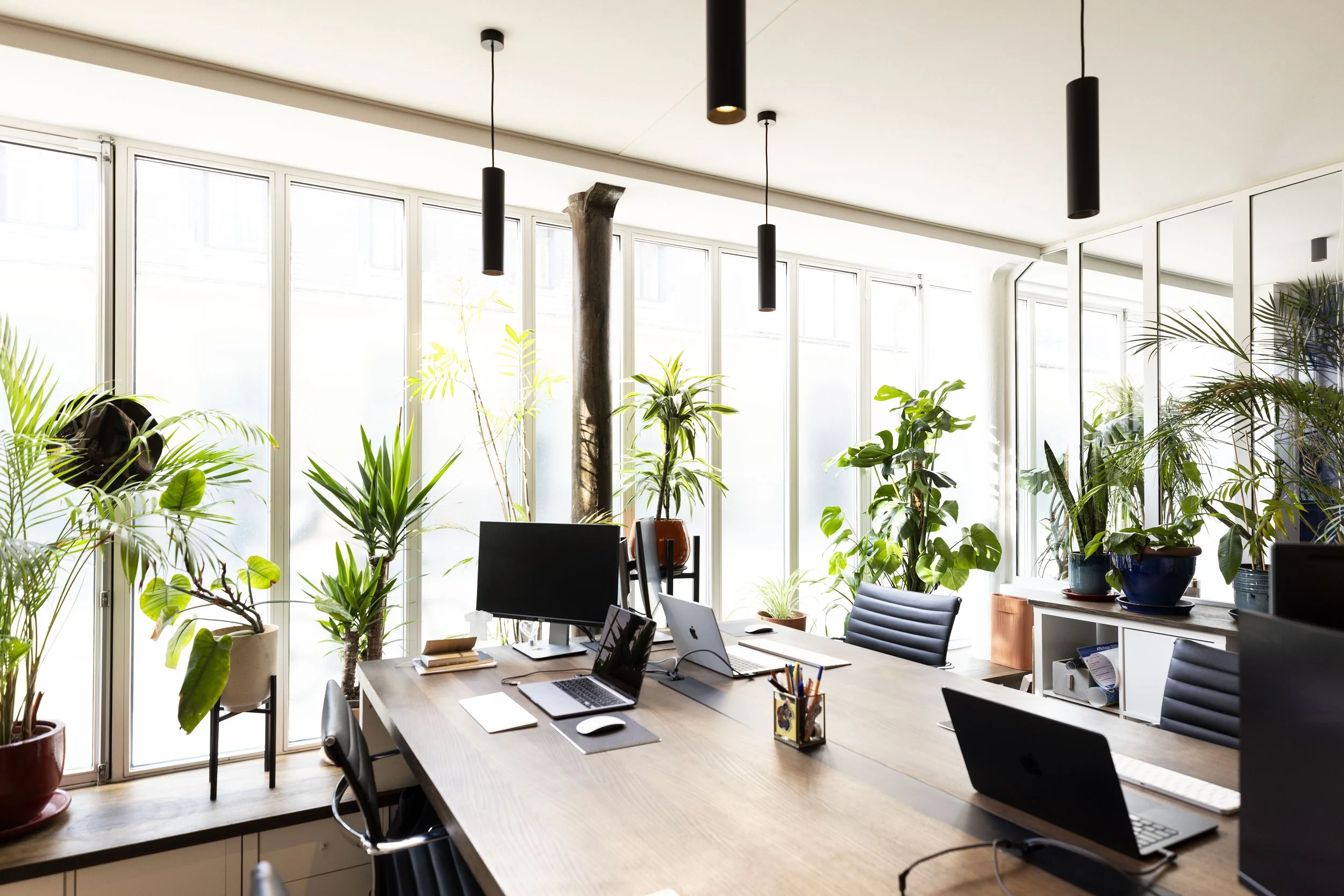
Microqlima by Red House
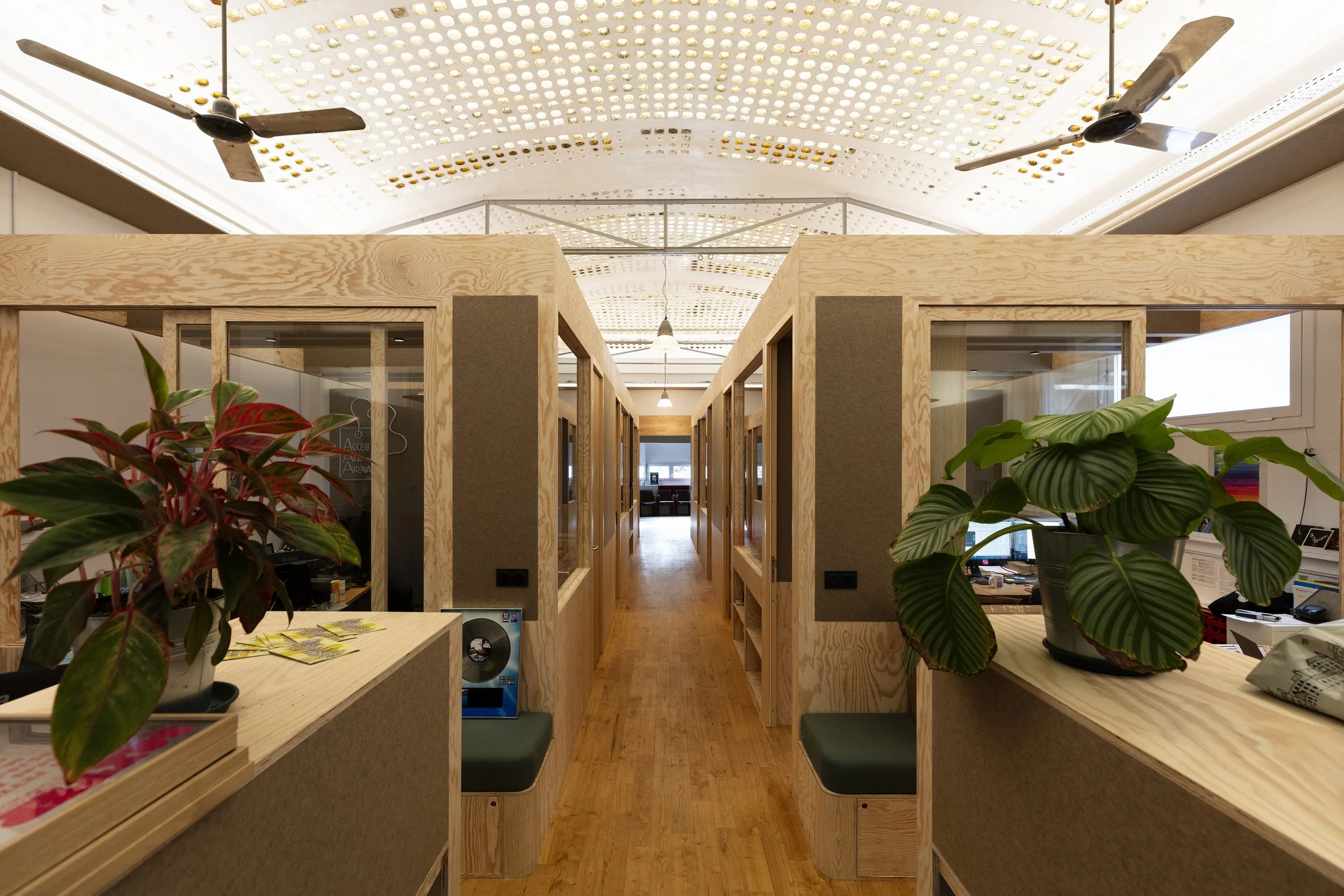
Talent Boutique by Red House
Planning an Office Acoustic Improvement Project?
Office Acoustic Solutions: frequently asked questions
-
To improve acoustics in an open-plan office, you must address the reverberation caused by reflective surfaces like glass and concrete. Implementing an acoustic treatment that combines sound absorbing material, such as fiberglass panels or acoustic ceiling tiles, helps to absorb sound waves and prevent them from bouncing across the room. Strategic placement of baffles and acoustic wall treatments will significantly lower the overall sound level and improve the acoustic comfort of the space.
-
To soundproof your office effectively, you need to focus on sound isolation and noise control to block airborne transmission between rooms. This often involves structural upgrades like installing soundproof windows, adding mass loaded vinyl to walls, or using door seals and caulk to eliminate any air gap where sound might leak. Unlike simple absorption, true soundproofing requires dense materials and decoupling techniques to create a functional sound barrier.
-
While acoustic panels are highly effective at reverberation control and improving speech clarity, they are usually just one part of a complete acoustic design. To fully reduce ambient noise and background noise, you may also need to consider acoustic ceiling systems, sound damping underlayments for floors, and even sound masking technology to cover unwanted distractions. A holistic approach ensures that sound energy is properly managed throughout the entire frequency range.
-
The best acoustic solution for office cubicles involves using absorptive desk dividers and acoustic foam inserts that provide a localized noise barrier. These fabric wrapped partitions act as an absorber to dampen immediate vocal reflections. Additionally, adding ceiling panels directly above workstations can help catch rising sound waves, while bass traps in the corners of the larger room can manage low frequency build-up that often travels through open desk layouts.
-
To reduce or drown out noise in a busy office, we implement a "SND" (Shield, Neutralize, Dampen) strategy. We shield workstations with acoustic partitions, neutralize distracting chatter with sound masking (adding a subtle, pleasing background sound), and dampen echo using melamine foam or mineral wool absorbers. This combination reduces noise pollution and ensures that traffic noise or HVAC hums do not interfere with the intelligibility of important conversations.
-
Office acoustic solutions significantly improve productivity by creating a quieter environment that allows for deep focus and reduces mental fatigue. When reverberant noise is minimized and speech privacy is protected, employees experience fewer interruptions. Studies show that optimized room acoustics and proper vibration control lead to higher accuracy and better overall well-being, as workers no longer have to compete with a noisy and stressful auditory landscape.
-
A company should invest in a professional acoustic study whenever they are moving into a new commercial space, planning a major renovation, or experiencing persistent employee complaints about noise level. A professional audit uses tools like a microphone and specialized software to measure the Sound Transmission Class (STC) and RT60. This ensures that the specification of materials—from fire rated panels to rockwool insulation—is perfectly tailored to your multipurpose needs and budget.
-
The main sources of noise in modern workplaces typically include ambient chatter from colleagues, mechanical sounds from ducts and HVAC systems, and impact vibrations from footsteps. Additionally, external factors such as traffic noise leaking through the building envelope and unwanted sounds from plenum spaces contribute to the problem. In many contemporary offices, the prevalence of reflective materials like drywall, metal, and glass amplifies these sound waves, making professional noise reduction essential.